





The Hitchhiker’s Guide to the Galaxy: Absurdity, Existence, and the Comedy of the Cosmos
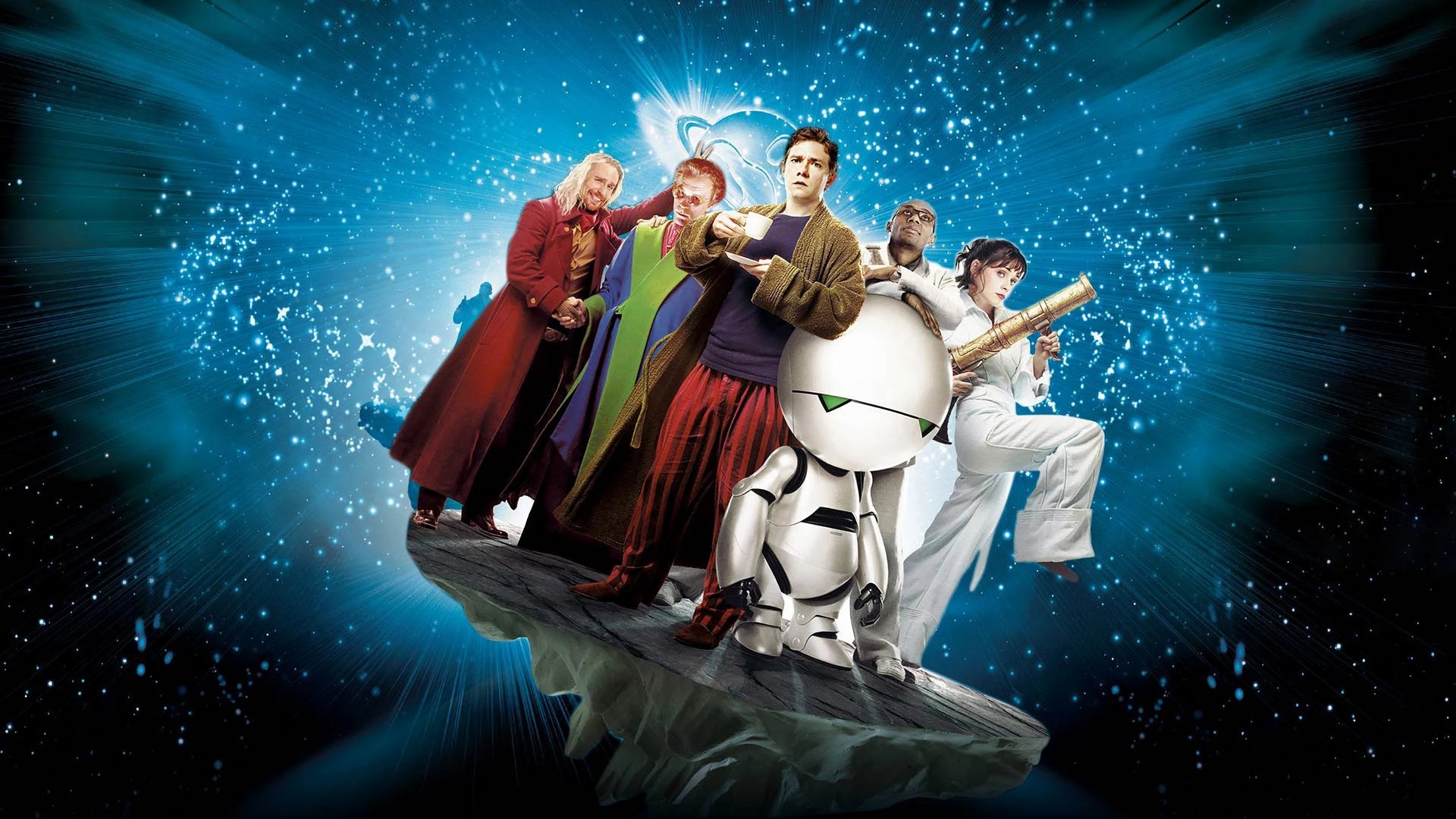
The Hitchhiker’s Guide to the Galaxy (2005) is a science-fiction comedy that embraces chaos, wit, and philosophical absurdity in equal measure. Based on the beloved novel by Douglas Adams, the film attempts the near-impossible task of translating one of the most imaginative and irreverent sci-fi stories ever written into a visual medium. Rather than grounding itself in realism, the movie fully commits to the bizarre, reminding audiences that the universe is vast, indifferent, and often hilarious.
The story begins with the most British apocalypse imaginable: Earth is demolished to make way for a hyperspace bypass. Arthur Dent, an ordinary and perpetually confused man, survives only because his friend Ford Prefect turns out to be an alien researcher for the titular Hitchhiker’s Guide. What follows is a cosmic road trip across space, filled with eccentric characters, improbable technology, and existential questions that are never taken quite as seriously as they should be.
At its heart, The Hitchhiker’s Guide to the Galaxy is not about saving the universe, but about finding meaning—or accepting the lack of it. The film playfully mocks humanity’s desire for purpose, logic, and importance in a universe that offers none of those things willingly. Concepts like the Answer to Life, the Universe, and Everything, the improbability drive, and deeply depressed robots are all used to explore existential dread through humor rather than despair.
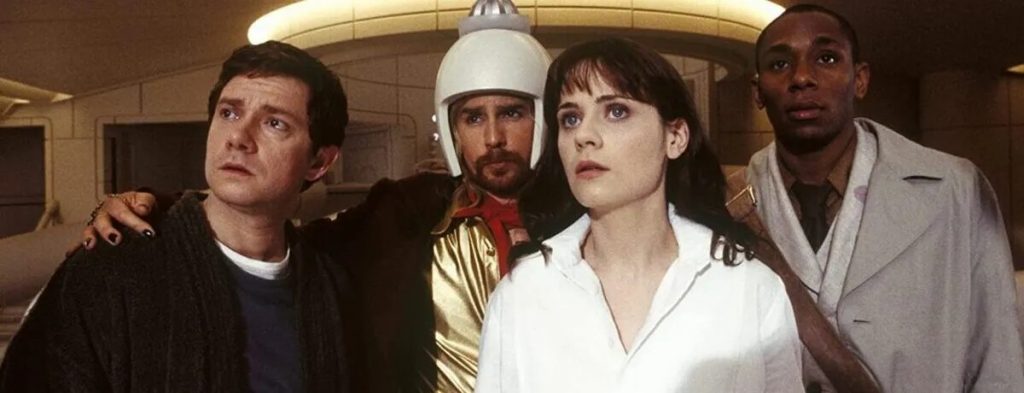
The cast brings Adams’ strange universe to life with enthusiasm and charm. Martin Freeman anchors the film as Arthur Dent, perfectly capturing his bewildered, reluctant-hero energy. Mos Def plays Ford Prefect with laid-back confidence, while Zooey Deschanel adds warmth as Trillian, the most grounded member of the group. Sam Rockwell steals many scenes as Zaphod Beeblebrox, the reckless, two-headed President of the Galaxy, and Alan Rickman’s iconic voice performance as Marvin the Paranoid Android adds dry, melancholic humor that resonates long after his scenes end.
Visually, the film embraces a whimsical, storybook aesthetic. Practical effects, imaginative creature designs, and exaggerated technology give the universe a deliberately unreal quality, staying true to the source material’s playful tone. The result is a world that feels handcrafted rather than polished, enhancing the sense that nothing in this universe should be taken too seriously—including existence itself.
Upon release, the film received mixed to moderately positive critical reception, with praise directed toward its performances, humor, and faithfulness to the spirit of Douglas Adams’ work, while some critics felt it struggled to fully capture the book’s depth and sharpness. The film holds a middling critical consensus but found stronger appreciation among fans of the source material. Commercially, The Hitchhiker’s Guide to the Galaxy performed respectably, earning just over $100 million worldwide against an estimated mid-range production budget, making it a modest box office success rather than a blockbuster.
Ultimately, The Hitchhiker’s Guide to the Galaxy is a film that rewards a particular mindset. It’s not meant to be neatly understood or emotionally conventional. Instead, it invites viewers to laugh at the absurdity of existence, accept confusion as a constant, and remember one essential piece of advice in the face of cosmic chaos: Don’t Panic.
